
Worried That Brain Stimulation Means Shock Therapy? How Exomind TMS Is Different
Hearing the term "brain stimulation" can feel unsettling, especially for those already navigating depression or treatment uncertainty. Exomind TMS is often confused with shock therapy or electroconvulsive therapy (ECT), but these treatments are fundamentally different. Understanding how Exomind TMS works, what makes it noninvasive, and what to expect during a physician-guided consultation can help you make informed decisions about your mental health care with greater confidence and clarity.
Patient also asks:
What does ECT mean?
ECT stands for electroconvulsive therapy. Some people may know it by older names like “shock therapy” or “electroshock therapy.” Modern ECT is a medical treatment performed in a controlled healthcare setting and is different from many older assumptions people may have about it.
Is Exomind TMS the same as shock therapy?
No. Exomind TMS is not shock therapy and is not the same as ECT. Exomind TMS uses magnetic stimulation to target specific areas of the brain. It does not require general anesthesia and does not intentionally cause a seizure.
Why do patients confuse Exomind TMS with ECT?
It is understandable to feel unsure when you hear the phrase “brain stimulation.” Some people may think of older mental health treatments or shock therapy. However, TMS and ECT are different treatments, and your provider can explain what to expect step by step.
Does iCare Mind Space provide ECT?
No. iCare Mind Space offers Exomind TMS therapy, not ECT. We include this information because many patients want reassurance that TMS is not the same as shock therapy.
How do I know if Exomind TMS may be right for me?
Exomind TMS may be discussed with adults who have major depressive disorder and have not had enough improvement from prior antidepressant medication during the current depressive episode. A consultation can help review your symptoms, treatment history, safety factors, and goals.
When “Brain Stimulation” Sounds Frightening
For some patients, the phrase “brain stimulation” can feel intimidating. It may bring up thoughts of shock therapy, electroshock therapy, hospital procedures, anesthesia, memory problems, or older ideas about mental health treatment.
That uncertainty is completely understandable. When someone is already dealing with depression, emotional exhaustion, poor sleep, or difficulty getting through daily life, the idea of trying an unfamiliar treatment can feel overwhelming.
Some patients may wonder, “Is this the same as shock therapy?” Others may worry about whether they will be put to sleep, whether the treatment will hurt, or whether it could affect their memory.
These are reasonable questions. Patients should never feel embarrassed for asking them. A clear, supportive conversation can help separate fear from facts and make the next step feel less uncertain.
What People Usually Mean by Shock Therapy
When people say “shock therapy” or “electroshock therapy,” they are usually talking about electroconvulsive therapy, also called ECT.
ECT is a medical treatment that uses carefully controlled electrical stimulation to intentionally cause brief seizure activity in the brain while the patient is under general anesthesia. It may be used in specific situations, such as severe depression, symptoms that have not improved with other treatments, or when a faster response may be needed.
It is important to talk about ECT with care and respect. ECT is a real medical treatment and should not be dismissed or mocked. Many fears about it come from older images, stories, or portrayals that may not reflect how modern ECT is performed.
However, ECT is still different from Exomind TMS. ECT involves anesthesia, seizure activity, and a more medically intensive treatment process. Exomind TMS does not use that same approach.
Exomind TMS is Different from Electroconvulsive Therapy
Exomind TMS uses transcranial magnetic stimulation, also called TMS. Instead of using electrical stimulation to intentionally cause a seizure, TMS uses magnetic pulses to stimulate targeted areas of the brain involved in mood regulation.
During Exomind TMS treatment, the patient stays awake. The treatment does not require general anesthesia, sedation, surgery, or implanted electrodes.
A simple way to understand the difference is this: ECT is designed to intentionally create controlled seizure activity while the patient is under anesthesia. Exomind TMS is not designed to cause a seizure. It uses magnetic stimulation while the patient is awake.
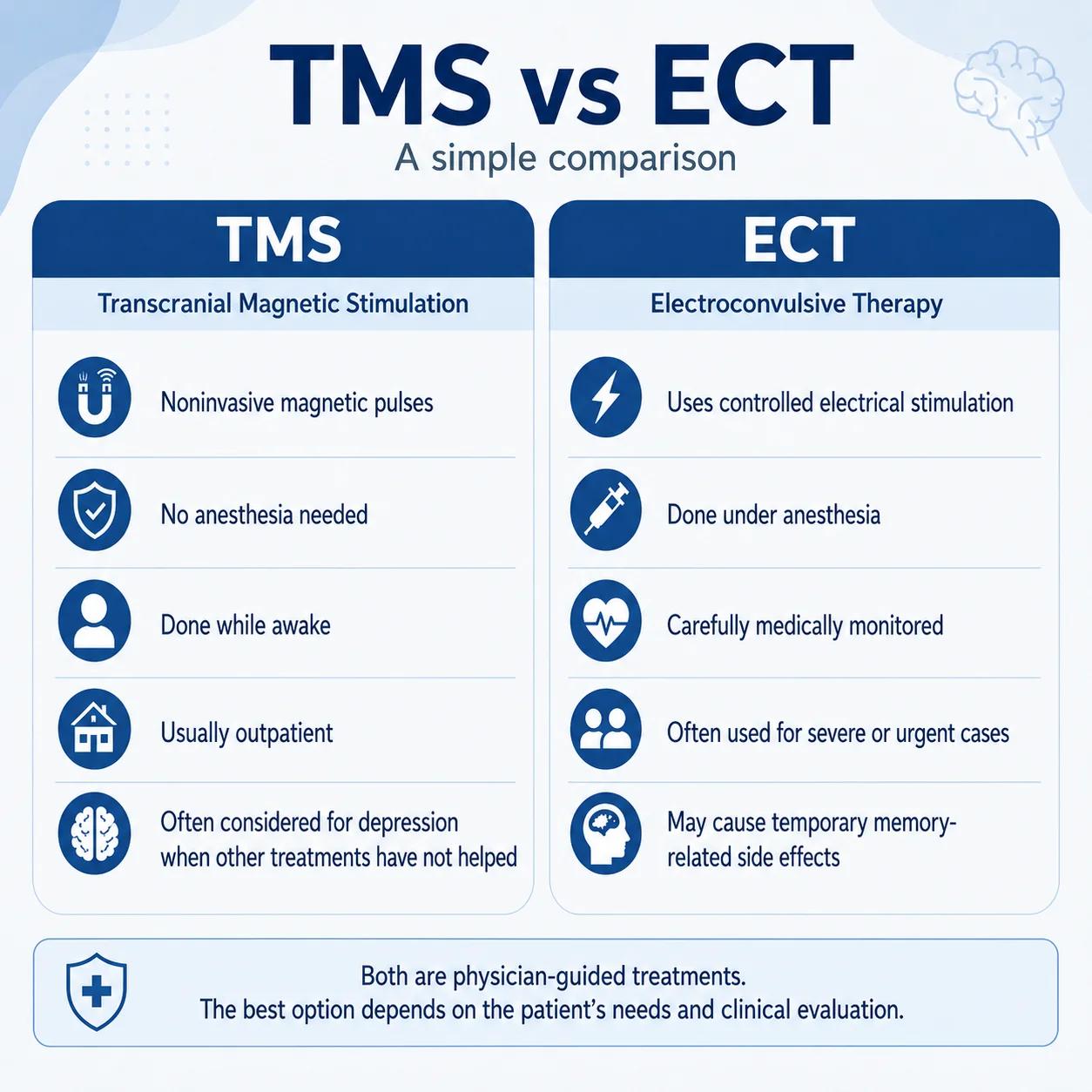
This difference matters because many patients feel nervous when they hear the words “brain stimulation.” They may imagine a treatment that is much more intense than what Exomind TMS involves.
At the same time, Exomind TMS is still medical care. Noninvasive does not mean casual. Patients still need proper screening, a careful discussion, and physician-guided review before starting treatment.
Patient also read: When Medication Is Not Enough: What to Know About TMS Therapy
Why Exomind TMS is Different from Shock Therapy
There are a number of reasons why Exomind TMS is different from ECT. What each treatment does and how each treatment works can be listed down for the patients’ clarification.
| Exomind TMS | Shock therapy / ECT |
|---|---|
| A transcranial magnetic stimulation | An electroconvulsive therapy |
| The patient remains awake during treatment. | The patient is placed under general anesthesia. |
| TMS is not designed to intentionally produce a seizure. | ECT intentionally causes brief seizure activity. |
| A magnetic stimulation | A controlled electrical stimulation |
This comparison is not meant to say that one treatment is always better than another. It is meant to gently clarify that Exomind TMS is not the same as shock therapy, even though both may sometimes be discussed as brain stimulation treatments.
Why the Difference Can Feel Reassuring
Many patients who ask about Exomind TMS are already carrying a lot. They may have tried medication and still feel low, emotionally heavy, or disconnected from daily life. Some may feel discouraged because they are doing what they can, but their symptoms are still affecting work, relationships, sleep, or self-confidence.

In that situation, fear can become another barrier. A patient may be curious about Exomind TMS but hesitate because the treatment sounds unfamiliar. Others may hold back from asking questions because they feel they should already understand the difference.
A calm explanation can help. Knowing that Exomind TMS does not require general anesthesia, does not involve surgery, and is not designed to cause a seizure can make the treatment feel less frightening to talk about.
That does not mean every patient will choose Exomind TMS. It simply means patients can make decisions with clearer information, rather than fear or confusion.
Why Exomind TMS Still Requires Careful Screening
Because Exomind TMS is noninvasive, some patients may wonder if it is automatically right for everyone. Before treatment begins, a provider should carefully review the patient’s diagnosis, depression history, current symptoms, medications, past treatment response, and safety factors.
Certain implants, metal near the head, a history of seizures, neurological concerns, or other medical factors may affect whether TMS is appropriate.
This step matters because the goal is not simply to start treatment quickly. The goal is to understand what is realistic, what is safe, and what results the patient may reasonably expect.
For some patients, Exomind TMS may fit well into the care plan. If it does, the medical team can guide the patient through the process with reassurance, proper support, and careful follow-up.
Questions to Ask if Brain Stimulation Makes You Nervous
Before starting any treatment, the medical team will do their best to help you feel comfortable asking questions. They understand that when a treatment sounds unfamiliar, it can feel intimidating or overwhelming.
You may want to ask:
- What is Exomind TMS, and how is it different from shock therapy?
- Will I be awake during treatment?
- Does treatment require anesthesia or sedation?
- What side effects should I understand?
- What safety factors could make TMS inappropriate for me?
- How will we monitor whether treatment is helping?
- Should I continue medication, therapy, or other parts of my care plan?
These questions can help turn fear into a clearer, more supportive conversation. If you still have concerns, your care team can take time to explain the process, answer your questions, and help you understand whether TMS therapy may be a good fit for you.
Exomind TMS Education at iCare Mind Space
At iCare Mind Space, we approach Exomind TMS as part of a thoughtful, physician-guided care plan.
This matters because depression can affect much more than mood. It may impact sleep, energy, focus, appetite, relationships, work, and the way a person moves through daily life. When patients are already carrying that weight, treatment decisions should feel clear, respectful, and supported.
For patients in Monterey Park, Rowland Heights, and nearby San Gabriel Valley communities, iCare Mind Space offers Exomind TMS therapy for eligible patients. iCare Mind Space does not provide ECT.
The goal is not to pressure patients into treatment. The goal is to help patients understand what Exomind TMS is, what it is not, and whether it may fit their symptoms, history, and overall care plan.
Take the Next Step with More Clarity
Hearing the words “brain stimulation” can make some patients pause. That pause is understandable. It may simply mean the patient needs more information, more reassurance, and a clearer explanation of what the treatment involves.
Exomind TMS is different from shock therapy or electroconvulsive therapy. It does not require general anesthesia, and the patient remains awake during treatment. Still, it should be discussed carefully with a provider who can review safety, fit, expectations, and the full care plan.
At iCare Mind Space, care begins with listening. If you are curious about Exomind TMS but nervous about what “brain stimulation” means, a consultation can help you ask questions, understand the difference, and take the next step with more confidence and support.
References
BTL. (n.d.). Exomind. https://bodybybtl.com/solutions/exomind
Mayo Clinic. (2023, April 7). Transcranial magnetic stimulation. https://www.mayoclinic.org/tests-procedures/transcranial-magnetic-stimulation/about/pac-20384625
Mayo Clinic. (2024, January 31). Electroconvulsive therapy (ECT). https://www.mayoclinic.org/tests-procedures/electroconvulsive-therapy/about/pac-20393894
National Institute of Mental Health. (n.d.). Brain stimulation therapies. https://www.nimh.nih.gov/health/topics/brain-stimulation-therapies/brain-stimulation-therapies
U.S. Food and Drug Administration. (2021). 510(k) premarket notification: BTL-995-rTMS. https://www.accessdata.fda.gov/cdrh_docs/pdf21/K212723.pdf